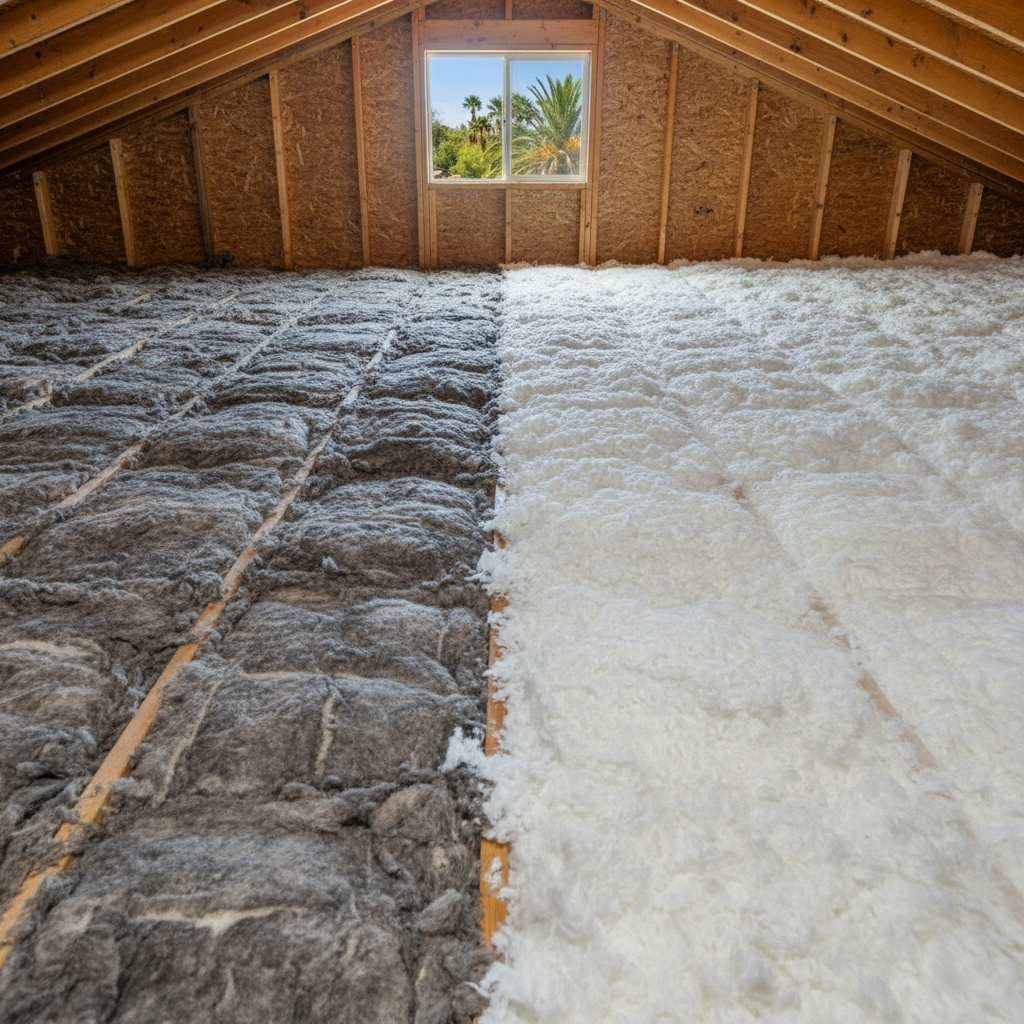
Alright, let's talk about your attic. Specifically, how you're keeping the heat out of it, or at least trying to. Here in Chandler, that's a constant battle, especially come July and August. When folks are looking to upgrade their attic insulation, two big contenders usually come up: blown-in insulation (fiberglass or cellulose) and spray foam. You've probably heard about both, but what's really the difference, and which one's going to work best for your home?
The Blown-In Basics: Fiberglass & Cellulose
First up, blown-in. This is what a lot of people think of when you say 'attic insulation.' It's those fluffy, loose-fill materials, either fiberglass or cellulose, that get blown into your attic space with a big hose. It's pretty effective at slowing down heat transfer, and it's generally a more budget-friendly option upfront.
- Cost: Typically, blown-in is cheaper to install than spray foam. You'll get a good R-value per dollar, especially if your attic is easy to access and doesn't have a ton of weird nooks and crannies.
- Installation: It's a fairly quick process. We can usually get a whole attic done in a day or less, depending on the size. It makes a mess, but we clean it up.
- Effectiveness: It does a good job of filling cavities and providing a thermal barrier. You'll definitely notice a difference if you're upgrading from old, sparse insulation.
- Durability & Maintenance: It's pretty durable as long as it stays dry and undisturbed. The main 'maintenance' is making sure it doesn't get wet (from a leaky roof, for example) and that it doesn't get compressed, which reduces its R-value. It can also settle over time, losing some of its initial thickness.
- Air Sealing: This is where blown-in has a big drawback. It's not an air barrier. It slows heat, but air can still move through it. If you've got leaks around your ceiling penetrations (light fixtures, plumbing stacks, etc.), that hot attic air is still finding its way into your living space. You'd need to air seal separately before blowing in insulation for the best results.
Spray Foam: The Modern Solution
Now, let's talk about spray foam. This stuff is a whole different animal. It's a liquid that gets sprayed onto surfaces – usually the underside of your roof deck or the attic floor – and then expands and hardens into a rigid, insulating barrier. We're talking about open-cell and closed-cell types, but for attics in Chandler, open-cell is often the go-to for roof deck applications because it allows for moisture vapor to pass through, which is important for roof health in our climate.
- Cost: No two ways about it, spray foam is more expensive upfront. It's a specialized product and requires skilled installers and equipment.
- Installation: It's a precise job. We suit up, protect everything, and carefully apply it. It expands quickly, so you see results fast. You'll need to be out of the house for a bit during and immediately after installation due to the off-gassing.
- Effectiveness: This is where spray foam shines, especially in our desert climate. It's not just an insulator; it's an air barrier. When applied to the roof deck, it brings your attic space into the conditioned envelope of your home. That means your attic temperature drops dramatically – from 140+ degrees down to maybe 90-100 degrees on a really hot day. That's huge for your AC system.
- Durability & Maintenance: Once it's cured, spray foam is incredibly durable. It won't settle, it won't get moldy (unless there's a persistent leak), and it doesn't degrade over time. It's pretty much a 'set it and forget it' solution.
- Air Sealing: This is its superpower. It seals every crack, every seam, every penetration. No more hot air sneaking in. This dramatically reduces your home's air leakage, leading to much better energy efficiency.
The Chandler Angle: Why It Matters Here
So, for us here in Chandler, what's the real takeaway? Our summers are brutal. We're talking 115 degrees for days on end. Our homes are constantly fighting that heat. The biggest enemy isn't just heat transfer through the ceiling; it's also the sheer volume of hot air that can get into your living space through all those tiny gaps and cracks in your attic floor.
With blown-in insulation, you're still dealing with a superheated attic, often 140-160 degrees. Your AC ducts (even if insulated) are running through that oven. Your AC unit itself is working harder in that environment. And any air leaks are pulling that scorching air right into your home. You'll get some relief, no doubt, but you're not solving the root problem of a superheated attic.
Spray foam, especially when applied to the roof deck, completely changes the game. It creates a sealed, semi-conditioned attic space. Your ducts are now running through an attic that's maybe 90 degrees, not 150. Your AC unit isn't fighting such extreme temperatures. This translates to significantly lower energy bills and a much more comfortable home. Plus, it can help prevent issues like ice dams in the rare event we get freezing rain, though that's not a common Chandler problem, obviously.
Think about the typical ranch-style homes we have all over Chandler, like in the older parts of Sun Lakes or even newer developments with complex rooflines. These homes often have large attic spaces that become massive heat sinks. Spray foam directly addresses that heat sink problem head-on by moving the thermal boundary to the roof itself.
My Recommendation for Chandler Homeowners
Look, if budget is your absolute top priority and you just need to bring your insulation up to code or get a basic improvement, blown-in insulation is a solid choice. It's effective, and it's definitely better than nothing or old, sparse insulation. Just make sure you address air sealing first.
However, if you're looking for the best long-term solution for energy efficiency, comfort, and durability in a Chandler home, I'm going to lean heavily towards spray foam. Yes, it's a bigger investment upfront. But the energy savings, the improved comfort, and the fact that it's a permanent air and thermal barrier make it pay for itself over time. It's a premium product, and it delivers premium results, especially in our extreme climate. We've seen it time and again at Chandler Spray Foam Insulation – customers are consistently blown away by the difference it makes.
It's not just about stopping heat; it's about creating a more efficient, comfortable, and durable home environment. And in a place like Chandler, that's priceless.